
Faithfulness in the Christian Life
By: Pastor Bailey Miller
Proper Pace
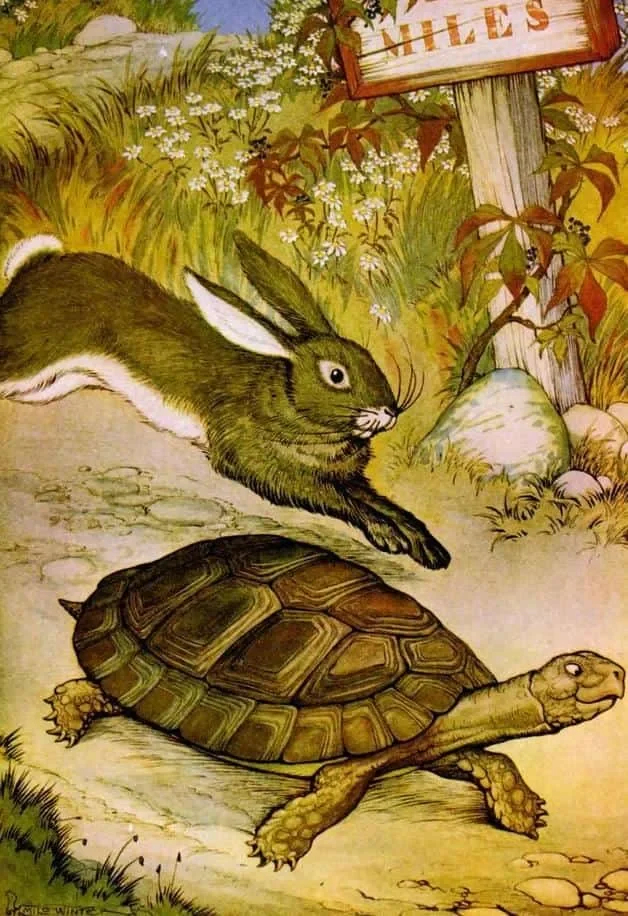
Many of us grew up hearing the familiar story of a race between a tortoise and a hare. In Aesop’s legend, a boastful Hare, overly confident in his speed, asks the Tortoise, “Do you ever get anywhere?” To which the peaceful Tortoise replies, “Yes, and I get there sooner than you think.”
The Tortoise is ultimately proven right, revealing that the race is not always to the swift. The same could and should be said of Christians in the race of faith.
In a world that champions speed, visibility, and breakthrough moments, the plodding pace of a tortoise seems like a lost cause. Yet within the Christian life, plodding carries a meaning that is both deeply countercultural and reflective of a hope anchored beyond this world.
This kind of life may not look impressive in the eyes of the world and may sadly even be neglected within the Church, but Scripture suggests it is exactly how God forms His people through the ordinary, repeated steps of obedience.
What Does It Mean to “Plod” Spiritually?
To plod, in the Christian sense, is to persist toward eternity over the course of one’s life even when visible fruit seems sparse and earthly rewards are absent. While the Christian hand may plant and water, it is inevitably and graciously God who gives the gain.
It is vital to remember that any gain experienced on this side of eternity is only a shadow of the eternal weight of glory awaiting beyond the fray of this life. Such reflection should also remind us of the many ways God has blessed us far more abundantly than we deserve.
As previously mentioned, the design of Christian life is indeed a unidirectional pursuit toward our Father in Heaven. Such a holy pursuit in a fallen world requires a certain righteous repetition as prescribed by the Living Word:
To meditate on scripture (Psalm 1:2)
To pray continually (Colossians 4:2)
To submit to God (James 4:7)
To gather with believers (Hebrews 10:25)
To confess and repent (1 John 1:9)
To give thanks (1 Thessalonians 5:18)
To serve others (Galatians 5:13)
To fight sin (Colossians 3:5)
To walk in love (John 13:35)
To endure faithfully (Hebrews 12:1)
As evidenced above, plodding is not passive religiosity; it is active perseverance. It’s also not a hamster wheel of hollow obedience, but an earnest pursuit of sanctification; It reflects a settled conviction that God is worthy of obedience regardless of the seasons, struggles, or emotions that befall us. In this way, plodding is an expression of love that matches the first and greatest commandment: God above all else, including self.
A Biblical Pattern: Walking, Running, Enduring
Though the Bible never uses the word plod, its central metaphors strongly imply it.
We are called to walk by the Spirit (Galatians 5:16). Walking is deliberate and sustained—it assumes repetition, direction, and patience. It is not hurried, but it is purposeful.
We are also told to “run with endurance the race set before us” (Hebrews 12:1). The emphasis is not on speed, but on endurance—the capacity to continue despite fatigue, resistance, or discouragement.
Paul echoes this in Galatians 6:9: “Let us not grow weary of doing good, for in due season we will reap, if we do not give up.” The promise of harvest is tied not to intensity, but to perseverance.
Even Jesus’ teaching reflects this rhythm. In Mark 4:26–29, the kingdom of God is likened to a seed that grows “he knows not how.” Growth happens slowly, quietly, and often invisibly. The biblical pattern is unmistakable: God works through time, and He calls His people to remain faithful within it.
The Threat of Familiarity
One of the quiet dangers of plodding is that repetition can, at times, begin to feel cold or ineffectual. Prayer can become routine and ritualistic. Scripture reading may seem dry or easy to replace with other busyness. General Christian obedience can feel mechanical or lacking immediate impact. Yet the Christian life was never meant to be sustained, much less guided, by feeling alone.
Love for God is proven not merely in moments of spiritual exhilaration or satisfaction, but in continued obedience when the heart feels weary and the path feels ordinary. Christ Himself said, “If you love me, you will keep my commandments” (John 14:15). This does not mean believers are wrong in their longing to see God move powerfully; indeed, it is right to pray expectantly to God and to desire deeper communion with Him. But Christian hope cannot find its culmination in emotional highs or visible manifestations alone.
Hope is strengthened and preserved through the daily disciplines God has graciously given: prayer, Scripture, repentance, worship, and steadfast trust. For it is often in these seemingly small acts of repeated faithfulness that God quietly forms enduring saints and a life of faithfulness is built.
The Hidden Strength of Steadiness
Plodding will never be glamorous. It will not draw attention or admiration. In fact, it may often leave us asking the same of ourselves that the Hare did of the Tortoise, “Do you ever get anywhere?” But Scripture tells a different story:
It is in steadfastness that faith is proven (James 1:3-4)
It is in endurance that the race is finished (2 Timothy 4:7)
It is in quiet faithfulness that God is most often at work (Philippians 2:13)
Over time, what feels like slow progress becomes the growth of deep roots, like a tree planted by streams of water that yields its fruit in due season. And in the end, that stubborn faithfulness of the saint who simply kept plodding is not just acceptable to God; it is pleasing to Him (Hebrews 11:6).
Much like the Tortoise said of the finish line in response to the Hare, the christian can echo in response to their own doubts and whims of the world, “Yes, and I get there sooner than you think.”